Where to See Seattle Floating Homes: Lake Union Walking Path & Kayak Etiquette

Seattle · Community Photo
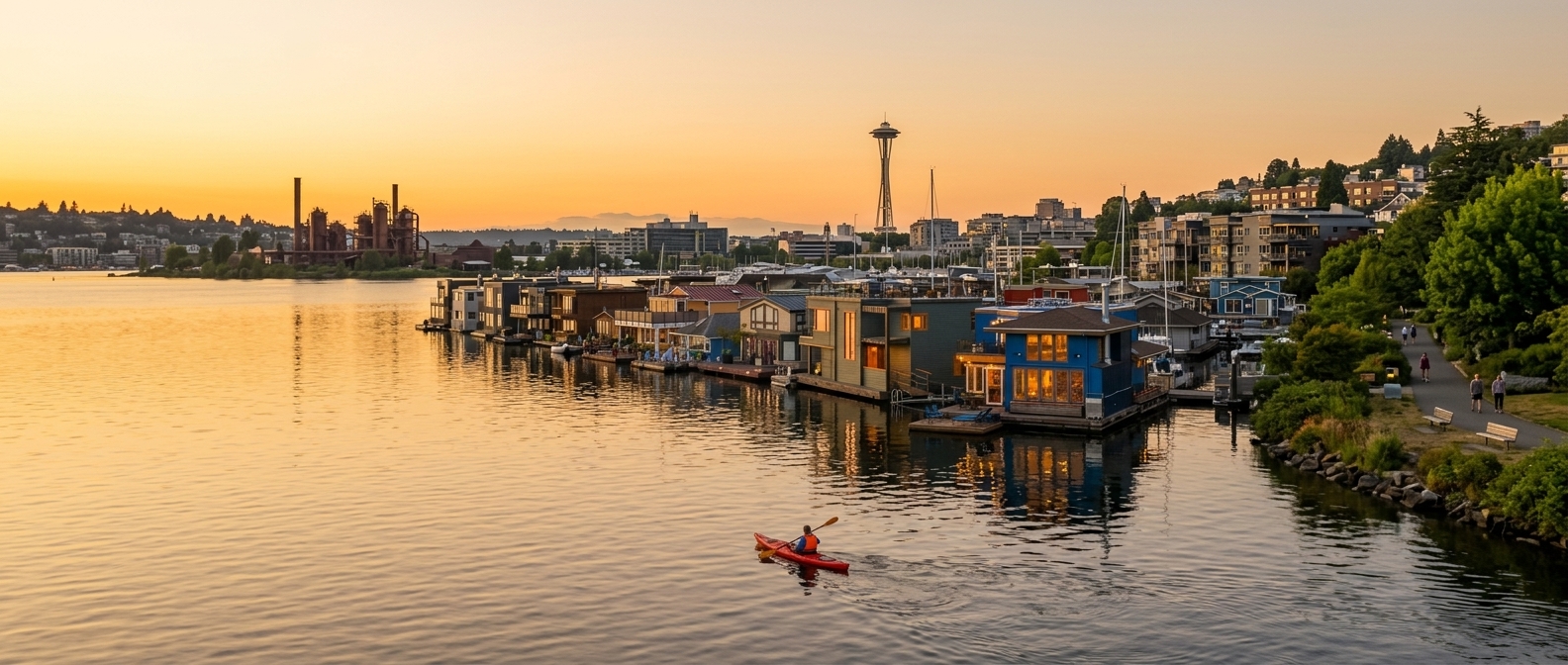
Explore Seattle’s iconic floating‑home neighborhoods without stepping onto private docks. This guide highlights the scenic lake Union walking path that threads past more than 35 public pocket parks and street‑end viewpoints, letting you admire historic houseboats from safe, public shorelines. For paddlers, the same waterway offers stunning close‑up views—provided you follow proven kayak etiquette, such as keeping a respectful distance from private docks, avoiding windows, and yielding to the flashing yellow seaplane advisory buoys that signal aircraft activity. By pairing the paved multi‑use loop with mindful paddling practices, you’ll capture the full charm of Eastlake’s floating homes while honoring resident privacy and maritime safety. Whether you prefer a leisurely stroll along the Cheshiahud Lake Union Loop or a calm kayak paddle at golden hour, you’ll find clear directions, essential safety reminders, and the best spots to photograph the skyline, including the Space Needle and Gas Works Park. Use this comprehensive playbook as your go‑to reference for where to see Seattle floating homes, the lake Union walking path, and the proper kayak etiquette that keeps the experience enjoyable for everyone.
Seattle floating homesline the shores ofLake UnionandPortage Bay, forming one of the city’s most photographed neighborhoods. Started by early loggers, mill workers, and fishermen who fashioned makeshift shelters on the water, the community grew through the Great Depression and later attracted boatbuilders, outlaws, and bohemian artists who shaped today’s distinctive architectural enclaves.
Maritime Heritage
The roots of this culture stretch back to the late 1800s, when cheap, floating cabins offered a practical solution for laborers needing housing near the burgeoning waterfront. Over decades the area evolved from a rough “shacktown” into a vibrant, tightly‑knit residential district celebrated in film and tourism alike.
Legal Distinction
Floating Home vs. Houseboat
Floating homesare permanent residences built on solid floats or logs, moored to dedicated docks with fixed sewer, water, and electricity connections supplied by Seattle Public Utilities.
Houseboatsresemble traditional boats; they feature propulsion or quick‑disconnect utilities, rely on holding tanks, and are typically rented on a slip rather than owned.
Responsible Viewing Options
Visitors can appreciate these communities without trespassing by using two low‑impact approaches:
By land: Follow the Cheshiahud Lake Union Loop, a paved 6‑mile circuit that links public pocket parks, street‑end water accesses, and scenic viewpoints such as Terry Pettus Park.
By water: Paddle quietly onLake UnionorPortage Bay, keeping a respectful distance from private docks and obeying the yellow flashing seaplane advisory buoys that require a 200‑foot clearance.
When you wonder where to see seattle floating homes lake union walking path kayak etiquette, remember that the best experiences combine the Loop’s public walkways with mindful paddling, honoring both the heritage and the privacy of this unique waterfront neighborhood.
Explore Seattle’s historic floating‑home neighborhoods without trespassing. Along the 6‑mile Cheshiahud Lake Union Loop you’ll find public shoreline parks such as Gas Works, Lake Union, and South Lake Union, each offering unobstructed views of the 507 floating homes that line the water. When you paddle, launch from popular spots like Moss Bay, Agua Verde, or the Center for Wooden Boats and glide past the same vibrant docks, keeping a respectful distance and obeying the seaplane advisory buoys that signal aircraft activity. The guide also clarifies the difference between lake union houseboats—vessels with propulsion that follow maritime navigation rules—and the permanently moored floating homes that are connected to municipal utilities. By following simple etiquette—staying on public walkways, avoiding private dock railings, and maintaining a courteous distance on the water—you can enjoy the iconic scenery while honoring the residents’ privacy. This balance of walking routes, kayak launch points, and respectful visitor practices makes the experience both memorable and community‑friendly.
Seattle’s Floating Home Heritage
Seattle floating homes began as modest shelters built by late‑19th‑century loggers, mill workers, fishermen, and boatbuilders who needed inexpensive places to live on the water. Over the decades those simple rafts evolved into a distinctive architectural enclave that now defines the city’s waterfront character.
At the height of their popularity, more than 2,000 floating structures dotted the shores of Lake Union and Portage Bay. Today a resilient subset survives, anchored across about 70 managed docks. Roughly500 floating homesand250 residential houseboatsremain, a living testament to the community’s perseverance.
The modern skyline of Lake Union houseboats blends historical grit with contemporary design. Concrete and foam platforms replace original log‑raft foundations, supporting everything from mid‑century bohemian cabins to multi‑story glass dwellings. Many feature expansive rooftop decks that invite owners to enjoy panoramic views of the city, the mountains, and the ever‑busy seaplane corridors.
Portage Bay houseboats share this spirit while fostering a close‑knit dock culture. Residents often gather for impromptu barbecues, communal clean‑ups, and neighborhood meetings, reinforcing a sense of place that feels both urban and nautical.
Visitors seeking the best way to see this unique scene should explore the public shoreline parks, street ends, and the 6‑mile Cheshiahud Lake Union Loop. Respectful viewing from these public points preserves privacy while showcasing the architectural charm of the floating community. For water‑based explorers, remembering to keep a courteous distance from private docks helps maintain the harmony that has endured for more than a century.
Category | Foundation / Hull Type | Mooring & Utilities | Propulsion | Legal Classification in Seattle |
|---|---|---|---|---|
Seattle Floating Homes (FHOs) | Built on a continuous float (historically treated logs; modern ones use concrete/EPS foam blocks). | Permanently moored in designated floating home docks; permanent direct connections to city water, sewer (Seattle Public Utilities), and electricity (Seattle City Light). | None (immovable without a professional towing operation; cannot travel between marinas). | SMC 23.60A.202: Regulated as housing and by statute not a vessel; assessed as personal property (transfers via bill of sale, no certificate of title). |
House Barges / Houseboats (Floating On‑Water Residences / FOWRs) | Built on a barge or flat‑bottomed float designed primarily as a floating residence rather than a traditional vessel hull. | Moored in recreational marinas; typically uses quick‑disconnect utility lines (garden‑hose water, 30‑amp shore power) and blackwater holding tanks requiring periodic pump‑out. | Usually non‑motorized or lacking primary self‑propulsion, but engineered to be towable between marinas. | SMC 23.60A.204 (House Barges) / SMC 23.60A.203 (FOWRs): Registered/verified floating‑on‑water residences. Personal property requiring city verification numbers under the Shoreline Master Program. |
Cruising Houseboats / Motorized liveaboards | Conventional boat or vessel hull (planing or displacement hulls designed for navigation). | Docked in slips with marina‑granted liveaboard status; relies on shore‑power chords, onboard water tanks/hake connections, and marine head/holding systems. | Equipped with functional inboard or outboard marine engines/motors capable of active self‑propulsion and navigation. | Liveaboards on Conventional Recreational Vessels (CRVs) under SMC Chapter 23.60A: Legally categorized as vessels/watercraft subject to Coast Guard documentation or state vessel registration, distinct from static floating residences. |
Walking the Cheshiahud Lake Union Loop: Best Shoreline Views & Pocket Parks
Overview of the Trail
TheCheshiahud Lake Union Loopis a ≈ 6‑mile paved, multi‑use route that circles Seattle’s urban lake. It weaves together sidewalks, boardwalks, and designatedlake union walking pathsegments, giving walkers continuous shoreline access while linking more than three dozen pocket parks and street‑end viewpoints.
From South Lake Union to Eastlake
Start at South Lake Union Park (860 Terry Ave N.) where historic ships and the Museum of History & Industry greet you. Head north along the loop, crossing the bustling South Lake Union corridor the iconicEastlake Seattle houseboatsthat line the water’s edge.
Continue past the charming “cottage‑style” docks until you reach the University Bridge. The bridge spans Portage Bay and offers sweeping panoramic views of sailboats, seaplanes, and the floating‑home community, making it a favorite photo spot.
Public Viewpoints and Pocket Parks
Along the way, the loop passes several pocket parks—Terry Pettus Park, Lynn Street Mini Park, and Fairview Park—each providing a legal, unobstructed perch for admiring the houseboats and marine traffic. These public boardwalks and street‑end viewpoints let you capture close‑up scenes without entering private dock areas.
Respectful Walking Etiquette
Visitors who wonderwhere to see Seattle floating homes lake union walking path kayak etiquetteshould remember these simple guidelines:
Stay on the paved sidewalks, boardwalks, or marked pocket‑park trails.
Do not step onto private docks or attempt to tie a kayak to residential moorings.
Keep a respectful distance from windows and doors; avoid peering directly into homes.
Watch for the five seaplane advisory buoys that flash yellow; give them a 200‑foot clearance when they activate.
Leave footprints only on designated paths and enjoy the view responsibly.
Overview
Walking east along Fairview Avenue offers direct views of the historic Eastlake Seattle houseboats that line Lake Union. The paved Lake Union walking path connects a series of public street‑end pocket parks, each providing a safe spot to pause, photograph, and respect the private docks beyond.
Terry Pettus Park
Location:2001 Fairview Ave E, at the intersection with E. Newton Street.
Key Features:A public pier and small boat launch give a clear foreground for lake scenery; the park is named for journalist Terry Pettus, who championed the preservation of the houseboat community.
Scenic Photo Perspectives:Stand on the pier to capture sweeping westward vistas of floating homes framed by the Seattle skyline.
Walker’s Tip:Arrive early on weekdays to avoid weekend crowds and enjoy unobstructed sightlines while the Lake Union walking path runs right beside the park.
Lynn Street Mini Park
Location:Fairview Ave E & E. Lynn St (address often cited as 2291 Fairview Ave E).
Key Features:A modest wooden viewing deck and a hand‑painted tile bench sit directly above the water, offering close‑up views of floating homes bobbing at the dock.
Scenic Photo Perspectives:The elevated deck frames the houseboats with Queen Anne Hill in the background, perfect for sunrise shots.
Walker’s Tip:Keep to the designated path and stay clear of the private dock rails; the park’s modest size makes it ideal for quick stops during a longer loop.
Fairview Park
Location:2900 Fairview Ave E, between E. Hamlin and Allison Streets.
Key Features:Home to the Eastlake P‑Patch garden, timber‑and‑steel stairs to the shoreline, and a hand‑carry boat launch that permits short‑term tie‑ups.
Scenic Photo Perspectives:Capture layered compositions that blend garden blooms with panoramic lake views and the distant houseboat clusters.
Walker’s Tip:Use the stairs for easy access and respect the 2‑hour limit on the launch area; the nearby walking path provides a seamless route to the next park.
Paddling Lake Union: Kayak Routes, Rentals & Public Launches
Launching from South Lake Union
Begin with a Seattle kayak rental at Northwest Outdoor Center (2100 Westlake Ave N) or Moss Bay (1001 Fairview Ave N). Both locations provide easy access to the water and a spot to launch your kayak for a day of kayaking Lake Union.
Eastlake Shoreline and Floating Homes
Paddle north along the eastern shore of Eastlake, keeping a respectful distance of at least 30 feet from private docks. This stretch offers clear views of the historic houseboats that line the water while honoring the floating‑home etiquette that protects residents.
Under the University Bridge into Portage Bay
Glide beneath the University Bridge and enter the quieter waters of Portage Bay, where portage bay houseboats create a charming backdrop. The area near Agua Verde Paddle Club provides a convenient spot to pause or re‑launch if needed.
Viewing Gas Works Park
Continue westward toward Gas Works Park to capture skyline vistas and the park’s industrial silhouette. Approaching from the north gives paddlers a panoramic perspective without crowding the popular launch points.
Weather and Environmental Tips
Check wind forecasts before heading out; sustained breezes above 10 knots can make paddling challenging. Lake Union enforces a 7‑knot speed limit, so keep wakes small to protect nearby docks. Plan around daylight hours and wear high‑visibility clothing on overcast days.
Route Planning: Beginner vs. Experienced
Beginnersshould stay close to shore and avoid the central shipping lane and the fast‑moving Montlake Cut.Experienced paddlerscan extend the loop through Union Bay, navigating under bridges while observing commercial right‑of‑way rules.
Following these guidelines helps you answer the common question where to see seattle floating homes lake union walking path kayak etiquette while enjoying a safe and scenic paddling adventure.
Location / Outfitter | Shoreline Area | Equipment / Access Type | Good For |
|---|---|---|---|
Northwest Outdoor Center | Westlake – 2100 Westlake Ave N, Suite 1, Seattle, WA 98109 | Single, double, and triple kayaks plus SUPs; dock‑level kayak launch on Lake Union | Ideal for Seattle kayak rental guests who need direct water access near Gas Works Park, private lessons, and group rentals; also suitable for weekday paddle sessions and weekend photo shoots. |
Agua Verde Paddle Club | Portage Bay / University District – 1303 NE Boat St, Seattle, WA | One‑person and two‑person kayaks and SUPs; dedicated launch ramp offering a kayak launch on Lake Union | Serves beginners to advanced paddlers wanting to explore the Montlake Cut and enjoy kayaking Lake Union routes, and offers convenient pickup for those planning a full‑day kayaking Lake Union adventure. |
Moss Bay | South Lake Union – 1001 Fairview Ave N, Seattle, WA 98109 | Sit‑in and double kayaks, paddleboards; marina dock provides a kayak launch on Lake Union | Provides guided tours and large‑group outings for Seattle kayak rental groups looking for a sheltered, 7‑knot speed‑limit zone; includes brief safety briefings for new paddlers. |
Public Street‑End Hand Launches (Fairview Park, Terry Pettus Park, Lynn St, Newton St) | Eastlake – various street‑ends along the eastern and southern shores of Lake Union | Unpaved hand‑carry launches for user‑owned kayaks and SUPs; free public kayak launch Lake Union access | Best for independent paddlers preferring a free Seattle kayak rental experience and easy connection to the Cheshiahud Lake Union Loop; offers quick access to nearby pocket parks such as Terry Pettus Park and Fairview Park. |
Kayak Etiquette and Dock Etiquette Seattle
Dock Etiquette & Privacy Guidelines
Seattle’s iconic floating homes on Lake Union and Portage Bay are private family residences, not tourist attractions or museums. When you walk the shoreline or paddle nearby, observing respectful behavior protects the comfort of the residents and preserves the unique character of these neighborhoods.
Stay off private moorage docks.Never step onto residential docks or tie a kayak, paddleboard, or boat to floating‑home decks, fingers, or floats. These docks are personal yards and entryways.
Maintain a safe water buffer.While enjoying kayak etiquette, keep a distance of at least15 to 20 feetfrom any floating home. This space shields privacy and gives residents room to move safely.
Keep voices low.Sound travels across open water, amplifying conversations and music. Speak softly, especially in the early morning or late evening, to avoid disturbing nearby households.
Respect visual privacy.Refrain from staring, peering, or pointing cameras, smartphones, or telephoto lenses directly into windows, porches, or living spaces.
Manage pets and waste.Leash pets at all times on public paths near the water and practice “pack‑in, pack‑out” by removing all trash.
These practices form the core of dock etiquette Seattle residents rely on to keep the waterfront welcoming for everyone. By following them, you help maintain floating home privacy while still enjoying the beautiful views.
If you’re searchingwhere to see seattle floating homes lake union walking path kayak etiquette, start at the public pocket parks along the Cheshiahud Lake Union Loop—such as Terry Pettus Park, Lynn Street Mini Park, and Fairview Park—where you can observe from the shore without intruding.
Lake Union Navigational Safety & Advisory
Lake Union is an active water runway for Kenmore Air seaplanes. Five seasonal advisory buoys line the lake’s north‑south centerline and flash yellow lights when a plane is taking off or landing. Boaters and paddlers must keep clear of the marked runway buoys and immediately move at least 200 feet east or west of the flashing zone. This precaution is a core part of lake union boating rules and helps protect everyone sharing the water.
Motorboat Wake and Right‑of‑Way
The lake’s speed limit is 7 knots, and all operators are liable for damage caused by wake. Larger commercial traffic—including Argosy Cruises tour vessels and harbor tugs—has priority in the central channels. Smaller motorboats and paddlecraft should yield, reduce speed, and stay well clear of the wake to avoid unsettling floating‑home residents and to maintain safe navigation.
Paddlecraft Personal Flotation and Sound Devices
Washington State law requires every kayak, canoe, or stand‑up paddleboard on Lake Union to carry a USCG‑approved personal flotation device for each person; children twelve and younger must wear one at all times. A whistle or other sound‑producing device must also be on hand to signal position in low visibility. Observing these practices is essential kayak etiquette and demonstrates respect for the privacy of docked floating homes.
Respectful Viewing of Floating Homes
When you’re exploring the shoreline on foot or by paddle, remember that the docks are private property. View the homes from public parks, street ends, or the Cheshiahud Lake Union Loop, and never tie off to a private dock or peer directly into windows. Following these guidelines lets you enjoy the unique architecture while honoring the community.
Seattle Houseboats FAQ – Where to See Seattle Floating Homes
No, the wooden dock walkways extending into the water are private residential property shared by homeowners. Visitors should stay on public viewing routes such as Fairview Avenue East, street‑end parks, and the Cheshiahud Loop. These paths give excellent views while respecting owners’ privacy. This answer is part of the Seattle houseboats FAQ and helps answer where to see Seattle floating homes Lake Union walking path kayak etiquette.
The iconic floating home featured in the 1993 film “Sleepless in Seattle” sits at 2460 Westlake Avenue North on the western shore of Lake Union. It is a private residence, not open to the public. This floating home is a classic example of a Sleepless in Seattle houseboat. You can admire it from a respectful distance, such as from a kayak or a guided boat tour that passes by without tying up to the dock.
Early mornings and late weekday afternoons provide the calmest flatwater on Lake Union. During these times motorized boat traffic and seaplane activity are minimal, reducing wake and offering clearer views of the skyline. The light at sunrise or golden‑hour also enhances photography, making it the ideal period for answering Lake Union kayak questions.
Yes, several local outfitters run guided tours that highlight Seattle’s floating homes. Northwest Outdoor Center at 2100 Westlake Avenue North offers 90‑minute kayak rentals starting at $36 and led tours that sail past historic homes. Agua Verde Paddle Club on Portage Bay provides similar trips, combining scenic paddling with commentary on the unique houseboat community.